
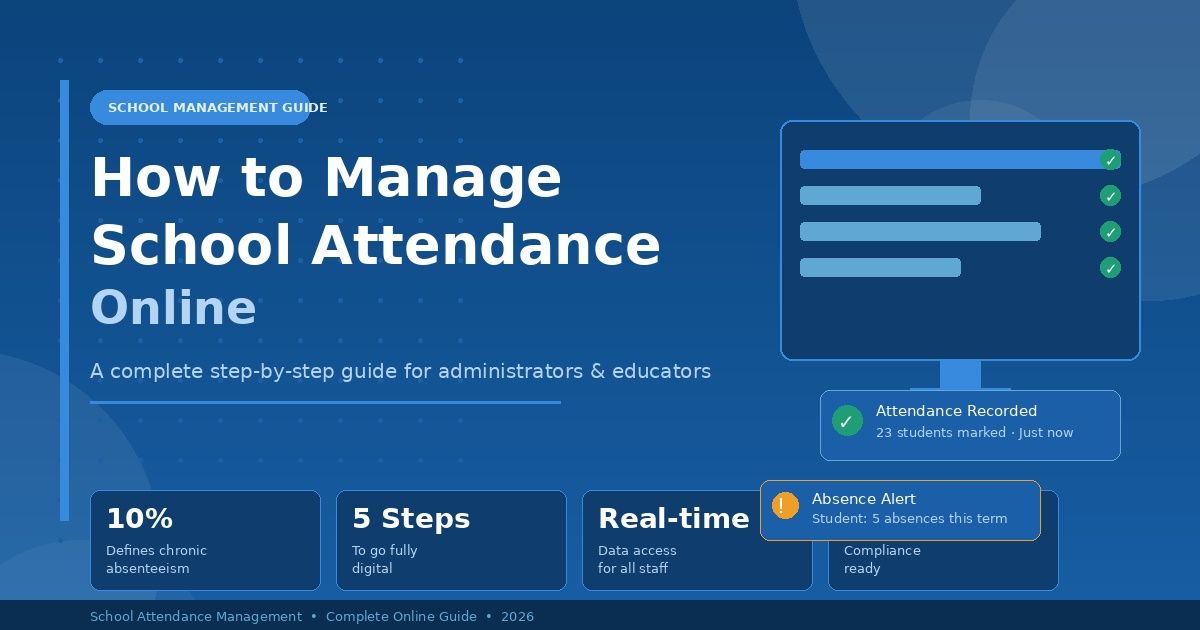
Managing student attendance has come a long way from paper registers and manual roll calls. Today, schools of all sizes are shifting to digital tools that make tracking attendance faster, more accurate, and easier to report. If you're an administrator, teacher, or school leader wondering how to manage school attendance online, this guide walks you through everything from choosing the right system to implementing best practices that save time and improve outcomes.
What Is Online Attendance Management?
An online attendance management system is software that lets teachers record student presence digitally through a web app, mobile app, QR code, or biometric scanner and that automatically compiles, reports, and shares that data with administrators, parents, and other school systems in real time. It's typically one module within a broader cloud-based school management platform that also handles gradebooks, communication, and fee management.
Instead of a paper register that sits in a filing cabinet until someone transcribes it weeks later, attendance data becomes immediately usable: dashboards update the moment a teacher marks a class, parents get a text if their child hasn't checked in, and administrators can pull a compliance report in seconds rather than days.
Quick Summary: The Process at a Glance
If you're short on time, here's the shape of the whole process:
- Choose a platform that fits your school's size, budget, and existing tools (SIS, LMS)
- Configure your attendance policy categories, thresholds, and excuse workflows — before going live
- Decide on tracking method(s): manual entry, QR code, biometric, or a mix
- Train teachers and brief parents with hands-on sessions, not just a PDF
- Monitor data daily and act on alerts rather than letting absences pile up
- Stay compliant with FERPA, GDPR, or your local equivalent from day one
- Track remote/hybrid attendance using participation signals, not just login timestamps
The rest of this guide covers each step in depth.
Why Attendance Data Matters More Than It Looks
Attendance is one of the strongest early signals of how a student is doing often more telling than grades, because it shows up before grades do. A student who starts missing one day a week is, in many cases, already showing the first sign of disengagement that will eventually affect coursework.
Schools that move attendance online typically see a few consistent shifts:
Less time on admin, more time teaching. Manual roll call can eat several minutes per class. Multiplied across a school day and a school year, that's a meaningful chunk of instructional time recovered simply by automating the record-keeping.
Real-time visibility instead of next-week visibility. When a parent gets notified the same morning their child is marked absent rather than finding out at a parent-teacher conference weeks later they tend to engage faster, which improves both accuracy (fewer unresolved absences) and outcomes.
Faster, less stressful compliance reporting. Districts that automate attendance reporting have cut the time spent compiling compliance documentation dramatically, because the reports that used to require manually combining spreadsheets from multiple classes now generate themselves.
Earlier intervention. Automated alert thresholds mean a student who's quietly drifting toward chronic absenteeism — defined by the U.S. Department of Education as missing 10% or more of school days in a year, around 18 days gets flagged after, say, three unexcused absences, not after thirty.
Choosing the Right Online Attendance System
Before comparing specific products, it helps to understand the broad categories of systems available, because the right choice depends heavily on your school's size, infrastructure, and how attendance is actually taken day to day
Types of attendance tracking methods
| Method | How it works | Best for | Watch out for |
|---|---|---|---|
| Manual digital entry | Teacher taps present/absent on a tablet or laptop | Any school, especially smaller classes | Still relies on the teacher remembering to do it each period |
| QR code check-in | Students scan a code (often per-session) with a phone | Secondary schools, large lecture-style classes | Needs a device per student; codes can be shared if not time-limited |
| Biometric (fingerprint/facial) | Scanner matches student to a stored profile | High-security campuses, preventing "buddy punching" | Higher upfront cost; requires parental consent under most privacy laws |
| NFC/ID card tap | Student taps a card on a reader | Schools that already issue ID cards | Cards can be lost or shared |
| Geofencing/GPS | Confirms a check-in happened within a defined location | Field trips, off-campus learning | Requires location permissions on personal devices |
Most schools end up using a primary method (usually manual entry or QR code) with a secondary method for edge cases like field trips or off-site classes.
Core features to prioritize
When evaluating platforms, look for:
- Real-time sync — attendance updates the moment it's recorded, visible to admins and parents immediately
- Multiple input methods — at minimum, web and mobile; QR or biometric if your school size justifies it
- Automated notifications — SMS and email to parents/guardians, configurable by absence type
- Analytics dashboards with exportable reports — for compliance and for spotting trends by class, grade, or demographic
- Integration with your student information system (SIS) and any LMS you already use, so attendance data doesn't live in a silo
Free vs paid attendance platforms
| Free tools | Paid platforms | |
|---|---|---|
| Cost | No license fee; sometimes donation-based | Per-user or per-campus subscription |
| Analytics | Basic counts, simple trend views | Predictive absenteeism flags, custom dashboards |
| Integrations | Manual CSV import/export | Direct API/SIS/LMS sync |
| Support | Community forums, limited email | Dedicated support, onboarding help |
| Compliance tooling | Basic export for audits | Built-in FERPA/GDPR workflows, consent management, audit trails |
Free tools work well for a single classroom, a small private school, or a pilot before district-wide rollout. Once you're managing multiple campuses, need predictive analytics, or have strict compliance reporting requirements, the time saved by a paid platform's automation tends to outweigh the subscription cost fairly quickly.
Practical tip: Run a free trial of two or three platforms with a small group of teachers before committing school-wide. Teachers are the ones using the system every single day their feedback on how fast and intuitive it feels is often more useful than a feature checklist.
Setting Up Your Digital Attendance Policy
This is the step most schools rush and the one that causes the most headaches later. Your attendance policy needs to be fully encoded into the system before go-live, not adjusted on the fly once teachers are already using it.
Define your attendance categories
At minimum, most schools need:
- Present
- Absent (Excused)
- Absent (Unexcused)
- Tardy
- Early Dismissal
Align these categories with whatever your local education authority or funding body requires for reporting some jurisdictions have specific codes that map to these categories, and getting this mapping right from the start saves a painful re-categorization exercise later.
Set automatic alert thresholds
Decide, in advance, what triggers an intervention. A common starting point is flagging a student after a set number of unexcused absences in a term (many schools use a number around five, then adjust based on what they see). The point isn't the exact number it's that the system, not a person scanning spreadsheets, does the flagging.
Configure digital excuse management
Set up a parent portal or app where guardians can submit absence notes directly. Route these to teachers for one-click approval or rejection, rather than emailed notes that get lost or have to be manually entered.
Choose daily vs. period-by-period tracking
Secondary schools generally need attendance taken at every period, since a student can be present for first period and absent for the rest of the day. Primary schools typically only need morning and afternoon registers. Get this configuration right at setup switching tracking granularity mid-year creates messy, inconsistent historical data.
Training Staff and Communicating With Parents
A system is only as good as the people using it. This step is where rollouts succeed or quietly fail.
Training teachers
Run hands-on sessions on the actual devices teachers will use not just a recorded walkthrough. Cover:
- Marking attendance from their classroom device
- Handling late arrivals and early departures mid-class
- Submitting and reviewing excuse notes
- Viewing their own class's attendance history and trends
Leave a one-page quick-reference guide for the first couple of weeks. Most resistance to new systems comes from people forgetting a small step, not from the system being genuinely hard to use.
Communicating with parents
Send a welcome message before go-live that covers:
- How they'll be notified of absences (SMS, email, app push)
- How to submit an absence excuse digitally
- Where to view their child's attendance record
- Who to contact if there's a data error
When parents know notifications are immediate, something useful happens: they start proactively messaging the school about planned absences before they happen, rather than the school chasing them afterward. That single shift improves data quality across the board.
Tracking Attendance for Remote and Hybrid Learners
"Online attendance management" doesn't only mean digitizing a physical roll call for schools running remote, hybrid, or blended programs, it also means defining what "present" actually means when a student isn't in the building.
Most platforms handle this through participation signals rather than a single check-in:
- Login activity : did the student access the platform during the scheduled session window?
- Live session attendance : joining a scheduled video class (via Zoom, Teams, or similar) counted automatically through LMS integration
- Coursework completion : submitting assignments or completing lessons on the days they're due, used as a secondary or combined signal
The key decision your policy needs to make explicit is: does a login count as "present," or does the student need to demonstrate active participation? Schools that rely purely on login timestamps often find students log in and then disengage which is exactly the kind of pattern an attendance system should be catching, not missing. Combining login data with assignment and live-session participation gives a far more honest picture, and it's the same data your early-warning thresholds should be watching.
Monitoring Data and Intervening Early
Once the system is live, the advantage is wasted if nobody looks at the data until report card time. Build a routine around it
| Action | Frequency | Responsible |
|---|---|---|
| Review attendance dashboard | Daily (morning) | Administrator |
| Run absenteeism report | Monthly | Admin + Counselors |
| Follow up with flagged students | As triggered | Class teacher / Year head |
| Hold parent meeting using attendance data | As needed | Teacher + Admin |
| Resolve unmatched excuse notes | Weekly | Office staff |
| Export compliance reports | Termly | Administrator |
The single most important habit here is real-time marking, not end-of-day entry. Beyond data quality, this matters in genuine emergencies if there's a lockdown or evacuation, an accurate live headcount is something administrators need within minutes, not at the end of the day
Ensuring Compliance and Data Privacy
Student attendance records are sensitive data, and the platform you choose needs to handle them accordingly. Specifically, verify:
- Regulatory alignment — under FERPA (in the US), attendance records are part of a student's "education record," meaning access must be limited to staff with a legitimate educational interest, and parents/eligible students have the right to inspect and request corrections. Under GDPR (in the EU/UK), attendance data counts as personal data requiring a lawful basis for processing, data minimization, and for biometric attendance methods specifically explicit consent, since biometric data is classed as special category data.
- Encryption at rest and in transit for all attendance records
- Defined data retention periods with clear rules on when and how records are archived or deleted
- Role-based access controls so only relevant staff can view or edit records
- Full audit trails showing who accessed or changed a record, and when this is the detail that turns a stressful compliance audit into a quick export
If your school is considering biometric check-in methods, build the parental consent process into your rollout plan from the start retrofitting consent after a system is already live is far more difficult than collecting it during onboarding.
Rolling It Out: A Realistic Timeline
Trying to switch the entire school to a new attendance system overnight is how rollouts fail. A phased approach works better:
Weeks 1–2 — Pilot. Run the new system in a handful of classes alongside (not instead of) your current method. Use this period to catch configuration issues wrong attendance categories, alert thresholds that fire too often or not at all, notification settings that need tuning.
Weeks 3–4 — Staff training and parent communication. Roll out hands-on training to all staff and send the parent welcome communication. Keep the pilot classes running as a reference point for other teachers.
Month 2 — School-wide go-live. Switch the whole school over, with the old method fully retired. Keep extra support available a dedicated person teachers can message with quick questions for at least the first two weeks.
Term 1 — First full reporting cycle. Run your first monthly absenteeism report and your first compliance export through the new system. This is where you'll find any remaining gaps in category mapping or report formatting, while there's still time to fix them before they affect a full term's data.
This timeline can compress for smaller schools or stretch for larger districts with multiple campuses, but the sequence pilot, train, go-live, first reporting cycle holds regardless of scale.
A worked example: picture a 600-student secondary school moving off paper registers. In weeks 1–2, three classes pilot the new system using manual digital entry the IT lead notices the default alert threshold (five unexcused absences) fires too late for their needs and tightens it to three. In weeks 3–4, the rest of the staff get hands-on training using that adjusted configuration, and parents receive the welcome email explaining how absence notifications will now arrive by text within the hour rather than via a note home at the end of the week. By month 2, the whole school is live, with the front office handling a brief spike in parent questions during the first few days. By the end of term 1, the school runs its first automated absenteeism report and for the first time, catches two students approaching the chronic absenteeism threshold in week 6 of term, rather than discovering it at the end-of-term review.
If you're still narrowing down which platform fits this kind of rollout, a side-by-side comparison of school management systems can help shortlist options before you start the pilot phase.
Best Practices for Ongoing Management
Once the system is running smoothly, a few habits keep it that way:
Take attendance at the same time every period or day. Consistency in when attendance is recorded makes the data meaningful for comparison over time a class marked at the start of period vs. five minutes in produces different numbers.
Never let attendance slide to end-of-day entry. Real-time marking is more accurate and, as noted above, critical in emergencies.
Review and clean up data weekly. Set a recurring reminder to resolve unmatched excuse notes or unresolved flags before they accumulate into a backlog that's painful to clear.
Give teachers visibility into their own class trends, not just administrators. Teachers are often the first to notice a pattern in a specific student they need the data to act on that instinct.
Use the data to recognize good attendance, not just flag bad attendance. A system that only ever generates warnings becomes something people dread checking. Use the same dashboards to celebrate students and classes with strong attendance it reinforces the behavior you want and makes the system feel less punitive.
conclusion
Switching to online attendance management is less about the software itself and more about what the data lets your school do: notice a pattern early, communicate with a parent the same day, and walk into a compliance audit with reports that already exist rather than ones you have to build from scratch.
Start with a platform that fits your school's size and existing tools, get your policy configured correctly before launch, train staff hands-on, and build the daily habit of actually looking at the dashboard. The setup takes real effort in the first term but every term after that, it gives that time back, and then some.
Ready to see what this looks like in practice? Get started with Clast and explore how attendance fits into a full school management platform.