
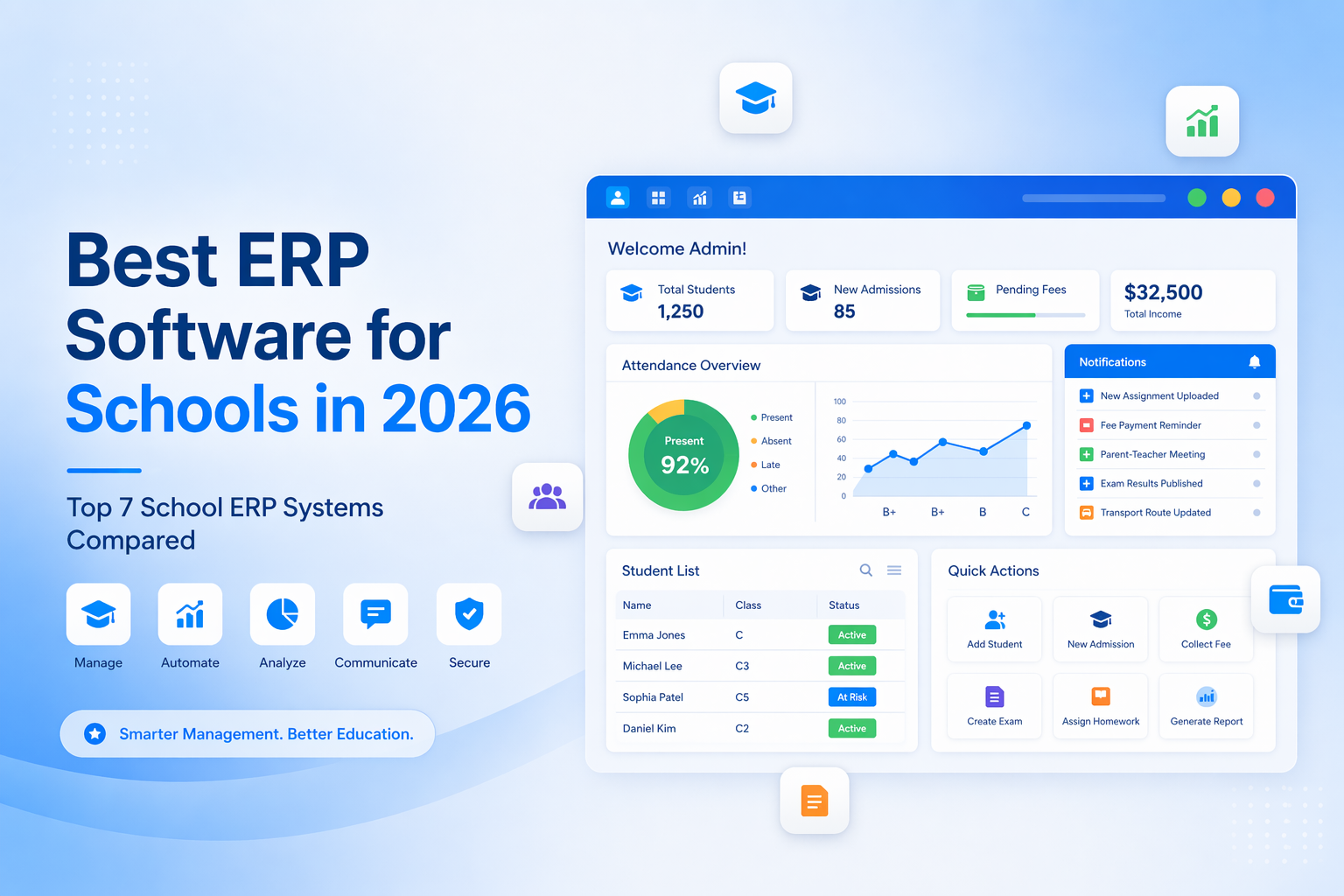
If your school is still juggling spreadsheets, disconnected tools, and manual processes you're already behind.
Managing admissions, attendance, fees, HR, and parent communication across multiple systems isn’t just inefficient it’s unsustainable in 2026.
That’s why more institutions are switching to school ERP software: a centralized system that automates operations, improves communication, and gives leadership real-time visibility.
In this guide, we’ll break down the best ERP software for schools in 2026, including features, pricing, pros, and who each platform is best for.
What Is the Best School ERP Software in 2026?
The best school ERP software in 2026 includes:
- Clast.io — Best overall modern ERP for schools
- Fedena — Best for multi-campus institutions
- Alma SIS — Best for K-12 user experience
- Classter — Best all-in-one SIS + LMS + ERP
- Infinite Campus — Best for US public school districts
- Entab CampusCare — Best for Indian schools
- SchoolMint — Best for enrollment and admissions
Top School ERP Software in 2026 (Comparison Table)
| Software | Best For | Pricing | Free Trial | Key Strength |
|---|---|---|---|---|
| Clast.io | Schools of all sizes | Flat-rate | Yes | Full ERP + AI + unlimited users |
| Fedena | Multi-campus schools | From ~$699/year | No | Deep module coverage |
| Alma SIS | K-12 schools | Custom | Demo | Excellent UX |
| Classter | Global institutions | From €4.50/student | Demo | SIS + LMS + ERP |
| Infinite Campus | U.S. districts | Custom | No | Compliance reporting |
| Entab CampusCare | India | Custom | Demo | GST + NEP 2020 support |
| SchoolMint | Enrollment-focused schools | Custom | Demo | Lottery & admissions |
How We Ranked These School ERP Platforms
We evaluated each platform using the factors schools care about most:
- Core ERP modules (fees, HR, attendance, academics)
- Ease of use for staff
- Parent/student mobile experience
- Reporting and dashboards
- Integrations
- Pricing clarity
- Scalability
- Regional compliance support
- Implementation complexity
- Overall value
What Is School ERP Software?
A school ERP system is software that helps educational institutions manage operations from one central platform.
Typical modules include:
- Admissions
- Attendance
- Fees & billing
- HR & payroll
- Timetables
- Exams & report cards
- Parent communication
- Student records
- Analytics & reporting
Instead of using separate systems for each department, everything connects through one shared database.
Why Schools Need ERP Software in 2026
Schools now face higher expectations than ever:
- Parents expect instant mobile updates
- Administrators need real-time reporting
- Compliance requirements keep increasing
- Staff need fewer manual tasks
- Leadership needs visibility across departments
Modern school ERP platforms solve these problems through automation and centralized data.
The Best ERP Software for Schools in 2026
1. Clast.io — Best Overall School ERP Software
Best for: Schools, colleges, academies, and universities looking for a modern all-in-one platform.
Clast.io combines student management, academics, finance, HR, communication, admissions, and analytics in one clean system. It is built specifically for education rather than adapted from generic business software.
One standout advantage is its role-based dashboards. Teachers, parents, finance teams, admins, students, and leadership each get interfaces tailored to their needs.
It also includes integrations with tools many schools already use, including Zoom, Google Workspace, Microsoft 365, Stripe, PayPal, and WhatsApp.
Key Features
- Student lifecycle management
- Attendance and assessments
- HR and staff management
- Fee collection and finance tools
- Parent and student portals
- AI reporting and analytics
- Messaging via email, in-app, WhatsApp
- Multi-campus support
Pros
- Modern interface with low training time
- Broad feature set in one platform
- Transparent pricing
- Strong communication tools
- Unlimited users/students on plans
Cons
- Newer brand than some legacy competitors
- Some niche modules may require integrations
Pricing: Clast.io uses simple, transparent flat-rate pricing. All plans include the full feature suite, unlimited users and students, AI tools, and priority support — with no hidden fees or per-module charges. Plans are available monthly or annually (annual billing saves 20%).
A 7-day free trial is available — no credit card required. Start your free trial at Clast.io →
2. Fedena — Best for Module Depth and Multi-Campus Management
Best for: Mid-size schools, chains, and campus groups.
Fedena has been operating since 2009, now serving over 40,000 institutions across 100+ countries. Built by Foradian Technologies in Bangalore, it offers over 50 modules — from admissions to GPS-tracked transport — and its open-source heritage gives it genuine configurability that purely commercial platforms often lack.
Multi-school management is a particular strength. Administrators managing multiple campuses can monitor all institutions from a single dashboard, with per-campus drill-downs available on demand.
Key Features:
- 50+ modules including admissions, gradebook, transport, library, and HR
- Multi-school management from a single dashboard
- Online examination and result management
- Fee management with online payment gateway integration
- Timetable generator
- Mobile app for students, parents, and teachers
- Moodle LMS integration
- Custom report builder and bulk data export
- Biometric and GPS tracking support
- API available for custom integrations
Pros:
- Extremely deep module coverage 50+ features in one platform
- Multi-campus management is among the best available
- Free open-source community version available
- Supports CBSE, ICSE, IB, state boards, and international curricula
- Strong API for custom integrations
- 15+ years in the market proven stability
Cons:
- Interface is functional but noticeably dated
- Navigation can be confusing users report needing time to find basic information
- Training resources have received mixed quality reviews
- Less suited to Western-style assessment and reporting
- Some users have flagged security concerns in older versions
Pricing: The community/open-source version is free. Commercial plans: Pro starts at approximately $699/year (20 core modules + 15 Pro modules, email support, webinar training). Pro Plus starts at approximately $1,111/year (adds 13 extra modules, data entry services, dedicated account manager, onsite training, priority support). Enterprise pricing is available for large institutions. View Fedena plans and pricing →
3. Alma SIS — Best for K-12 Schools Prioritizing User Experience
Best for: K-12 schools and districts in the US and internationally, especially those switching from legacy SIS platforms
Alma was purpose-built for K-12 education not retrofitted from a corporate tool and that shows in every corner of the interface. As the first SIS to partner with Google, it integrates natively with Google Classroom, as well as Microsoft Teams, Canvas, and Schoology Learning. Teachers frequently report being able to use the system confidently from day one.
In 2026, Alma has significantly expanded its analytics and data visualization capabilities, giving administrators better insight into school-wide trends without having to run custom reports.
Key Features:
- Student information management (demographics, attendance, health records, transcripts)
- Gradebook and report card generation
- Master scheduling and course management
- US state compliance reporting
- Parent and student portal with real-time access
- Customizable progress reports
- Health and special education (IEP) tracking
- Native Google Classroom and Microsoft Teams integration
- Communication tools for teachers, families, and administrators
- Advanced data analytics and visualization dashboards
Pros:
- Genuinely intuitive UI minimal training required for teachers
- Exceptional customer support, consistently praised in reviews
- Often significantly cheaper than major legacy competitors
- Native Google and Microsoft integrations
- Constantly updated based on user feedback
- Cloud-native no on-premise infrastructure needed
- Works for individual schools and large districts alike
Cons:
- Custom pricing only no published rate card
- Progress report formatting can be rigid for non-standard curricula
- Integrations can take longer to roll out than at larger vendors
- Not a full ERP limited on operational modules (payroll, transport, inventory)
- Primarily US-context; less useful for international institutions
Pricing: Alma uses fully custom pricing based on school size, enrollment, and features needed. Reported starting pricing is around $5,000/year for smaller schools, scaling up significantly with district size. No free plan, though demos are available. Request a demo at Alma →
4. Classter — Best for International Schools and Universities
Best for: International schools, universities, and multi-institution groups needing SIS + ERP + LMS in one platform
Classter combines SIS, ERP, LMS, and CRM into a single platform — trusted by 500+ institutions and 300,000+ users worldwide, built on Microsoft Azure infrastructure. Its modular pricing model means you pay only for what you activate, and GDPR compliance is built in from the ground up — a genuine advantage for schools operating across European data jurisdictions.
Classter integrates with over 40 popular tools, including Moodle, Google Meet, Zoom, and Microsoft Teams, and its API-first architecture supports custom connections with virtually any third-party system.
Key Features:
- Admissions and enrollment management with self-service applicant portal
- Billing and financial management with invoice and contract generation
- Full Student Information System (SIS) with academic records
- Learning Management System (LMS) with assignments and assessments
- CRM for student recruitment and relationship management
- Transportation and library management modules
- Alumni management
- 40+ integrations (Google Meet, Zoom, Microsoft Teams, Moodle, and more)
- GDPR-compliant consent management
- API-first architecture
- Microsoft Azure security infrastructure
Pros:
- Combines SIS + LMS + ERP + CRM genuinely reduces tool fragmentation
- Pay only for the modules you activate
- GDPR compliance is native, not bolted on
- Strong international track record across Europe, Middle East, and beyond
- Azure-backed security
- Responsive support team consistently praised in user reviews
Cons:
- Feature depth can overwhelm administrators at first onboarding investment required
- Mobile app doesn't yet offer full platform functionality (actively being expanded)
- Designed around term/semester periods less flexible for weekly-rotating programs
- Some reports require customization before matching specific institutional formats
Pricing: Classter pricing starts at €4.50 per student and scales based on the number of active students and which modules you activate. Annual and bi-annual billing options are available. Custom enterprise pricing available for larger institutions. View Classter pricing →
5. Infinite Campus — Best for US Public School Districts
Best for: K-12 public school districts in the United States, especially those with complex state reporting requirements
Infinite Campus is the largest natively built student information system designed specifically for US public education, serving districts from 30 to 330,000+ students. A single-database architecture eliminates duplicate data entry, and the platform maintains its own Tier 4 data centers with fully redundant sites a strong guarantee for uptime and data security.
US state reporting compliance is where Infinite Campus is unmatched. For public school administrators navigating federal program tracking, special education mandates, and state department data requirements, it's the most compliance-ready solution available.
Key Features:
- Comprehensive SIS with single-database architecture
- Attendance, grades, schedules, and transcripts
- Special education and IEP management
- Health records and nurse documentation
- Parent and student portal with real-time access
- Behavior and intervention tracking
- US state compliance and federal program reporting
- iOS and Android mobile apps
- Emergency notifications and mass messaging
- Premium add-ons: food service, HR and payroll, finance, voice messenger
Pros:
- Best-in-class US state compliance reporting built, not adapted
- Single-database architecture eliminates data duplication
- Scales from small districts to 300,000+ students
- Tier 4 redundant data centers for enterprise-grade uptime
- Real-time access for teachers, students, and parents
- Well-established with deep district-level support networks
Cons:
- Navigation is frequently described as confusing and non-intuitive by users
- Limited customization compared to more flexible platforms
- UI is functional but dated lags significantly behind newer competitors
- Premium modules (HR, payroll, food service) are extra cost on top of base pricing
- Essentially a US-only product — minimal value for international institutions
Pricing: Custom pricing based on district size. Reported starting price: approximately $3 per student per year for basic functionality. For smaller districts, monthly per-user costs run around $5; for 1,000+ users, this decreases toward $3/user/month. Implementation costs typically range from $5,000–$20,000 for smaller districts and $50,000–$100,000+ for larger institutions. Contact Infinite Campus for a quote →
6. Entab CampusCare — Best for Schools in India and South Asia
Best for: Indian schools on CBSE, ICSE, and state boards, residential schools with hostel and transport management needs
Trusted by over 2,300 schools across India with 23+ years in the market, Entab's CampusCare is the most locally tuned ERP platform for the Indian schooling context. NEP 2020 compliance is built into the platform's core — not treated as an afterthought. GST-compliant fee receipts, biometric attendance, GPS bus tracking, and hostel management are all covered natively.
Three product tiers serve different institutional needs: CampusCare (enterprise, full customization), CampusSoft (standard ready-to-use), and CampusKidz (purpose-built for pre-schools).
Key Features:
- Admissions and enrollment management
- GST-compliant fee collection and online payment
- Biometric attendance integration
- Transport management with GPS bus tracking
- Hostel management for residential schools
- Exam and result management with digital report cards
- NEP 2020-compliant academic workflows
- Library management
- Parent, teacher, principal, and management portals
- Mobile apps for all stakeholders (iOS and Android — 4.3 stars, 400,000+ installs)
- SMS, email, and WhatsApp communication
- MIS reporting and analytics
- Smart card integration for transport and library access
Pros:
- Deeply India-specific NEP 2020 and GST handling are first-class
- 23+ years of market experience in Indian education
- Residential school features (hostel, transport, GPS) are genuinely comprehensive
- Strong peer community of 2,300+ schools for references
- Multiple product tiers fit schools of different sizes and budgets
- Solid mobile app with strong user ratings
- Responsive 24/7 technical support
Cons:
- Designed exclusively for the Indian market limited value outside South Asia
- Pricing requires direct inquiry no public rate card
- UI design is more functional than modern
- Standard (non-enterprise) tier has some feature limitations
- International payment gateways and multi-currency support are limited
Pricing: Pricing is not publicly listed and is calculated based on school size, modules selected, hosting model (cloud vs. on-premise), and product tier chosen. Contact Entab directly for a personalized quote and demo. Request a demo from Entab →
7. SchoolMint — Best for Enrollment-Focused Schools and Charter Networks
Best for: Charter school networks, public school districts using school choice or lottery models, magnet programs, and city-wide enrollment systems
SchoolMint is the best-in-class solution for the specific, complex world of school choice enrollment an area where general-purpose ERP platforms typically fall short. Its Enroll 2.0 update brought a live open-seat tracker (real-time seat visibility across all programs and grades), interactive boundary management, and deeper analytics integration. It syncs with major SIS platforms including PowerSchool, Skyward, and Aeries making it an effective complement to an existing ERP, not necessarily a full replacement.
Key Features:
- Application and lottery management with transparent, auditable algorithms
- Live open-seat tracker across programs and grades
- Interactive geographic boundary management
- Single-application multi-school submission for families
- Waitlist management and automated placement
- Student re-enrollment and registration management
- Parent/guardian communication portal with real-time application status
- Digital form and document management with e-signatures
- Automated notifications (email, text, voice)
- SchoolFinder integration for family-facing school search
- SIS integrations with PowerSchool, Skyward, and Aeries
- Enrollment analytics and reporting
Pros:
- Best-in-class for lottery, waitlist, and school choice enrollment complexity
- Transparent enrollment processes that build family and community trust
- User-friendly interface for both administrators and parents
- Strong SIS integrations complements existing systems
- Automated notifications reduce staff workload significantly
- Consistently praised customer support (though see cons)
Cons:
- Not a full ERP does not cover academics, HR, finance, or operations
- Works best alongside another platform, not as a standalone solution
- Support quality has received mixed reviews recently some users report slow response times
- Limited to English language
- No API available for custom integrations
- Pricing is fully custom — no public rate card
Pricing: SchoolMint uses annual subscription pricing customized per organization, based on enrolled student count and modules required. Contact SchoolMint directly for a quote. Visit SchoolMint →
How to Choose the Right School ERP Software
Choose Clast.io if you want:
- Full ERP in one platform
- Modern UX
- Finance + HR + academics together
- Transparent pricing
Choose Fedena if you want:
- Deep module customization
- Multi-campus control
Choose Alma SIS if you want:
- Fast teacher adoption
- Great K-12 experience
Choose Classter if you want:
- International operations
- SIS + LMS + ERP together
Choose Infinite Campus if you want:
- U.S. compliance reporting
Choose Entab if you want:
- India-specific workflows
Choose SchoolMint if you want:
- Better admissions and lottery management
Questions to Ask Before Choosing a School ERP
Before signing any contract, ask vendors:
- What is included in the base price?
- Are implementation fees extra?
- How long does migration take?
- Is staff training included?
- How responsive is support?
- Is the parent app fully functional?
- Can we speak to current customers?
- What happens if we outgrow the plan?
Conclusion
There’s no single “best” ERP system for every school only the one that fits your needs.
- Choose Clast.io for a modern all-in-one solution
- Choose Fedena for deep customization
- Choose Alma SIS for ease of use
- Choose Classter for global institutions
- Choose Infinite Campus for compliance-heavy districts
- Choose Entab for Indian schools
- Choose SchoolMint for admissions-focused needs
Start by identifying your biggest operational problems then choose a school ERP system that solves those first.