
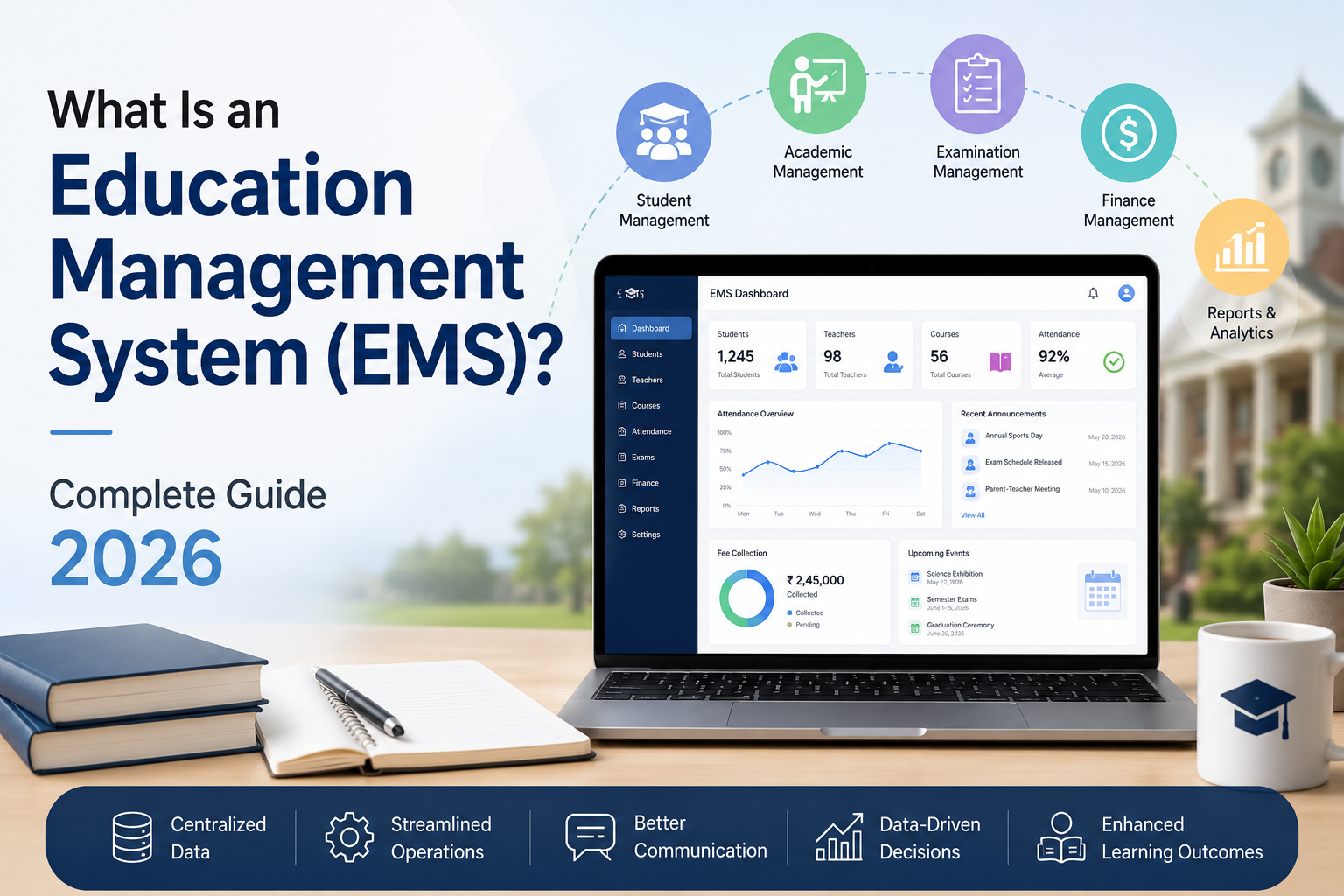
Managing a school, college, or university involves hundreds of overlapping processes every day. An Education Management System brings them into one platform and this guide tells you exactly what it is, how it works, and how to choose the right one.
What Is an Education Management System (EMS)?
Definition
An Education Management System (EMS) is a digital platform that centralizes and automates the administrative, academic, and operational processes of educational institutions from student admissions and attendance tracking to grade management, fee collection, staff administration, and real-time analytics.
Rather than managing student records in spreadsheets, attendance in paper registers, and fees through manual invoices, an EMS connects every department of a school, academy, college, or university into a single, cloud-based platform. When a teacher marks attendance, that data is instantly available to administrators. When a student submits an assignment, parents can see it. When a fee is paid, the finance team's dashboard updates in real time.
This is why educational institutions worldwide are replacing fragmented legacy tools with a single Education Management System it eliminates data silos, reduces human error, and saves hundreds of administrative hours per semester.
EMS vs EMIS Explained
The EMS full form in education is Education Management System. It refers to software used by individual educational institutions schools, academies, colleges, and universities to manage their day-to-day operations.
The EMS full form in school is the same: Education Management System. Whether you encounter it written as "EMS," "EMS education management system," or "educational management system," all of these refer to the same category of institutional software.
EMIS (Education Management Information System) is different. EMIS is used at the national or government level by ministries of education and bodies like UNESCO to collect country-wide education data for policy planning and SDG monitoring. EMS operates at the institutional level: your school or university. If you are an administrator or principal looking for software for your institution, you need an EMS, not an EMIS.
You may also see related terms in use:
- Academic Management System : focuses on the academic side (grades, timetables, curricula)
- School Management System (SMS) : usually synonymous with EMS for K-12 institutions
- Student Information System (SIS) : a component focused specifically on student data and records
- Education ERP : enterprise-level EMS covering finance, HR, and operations at large universities
How an Education Management System Works (Step by Step)
A modern EMS follows a clear operational loop from institution setup through continuous improvement. Here's how it works in practice:
- Institution Setup
Administrators configure the system: adding classes, subjects, academic calendars, fee structures, staff profiles, and student data. This becomes the foundation for every other module.
- Admissions & Enrollment
Students apply and enroll through the platform online or in-person. Their profiles, documents, and records are stored securely in one place from day one.
- Daily Academic Operations
Teachers mark attendance digitally, schedule classes, assign work, record grades, and track academic progress all from a single dashboard accessible on any device.
- Real-Time Communication
Parents receive automatic notifications about attendance, grades, and announcements via the platform's messaging system or mobile app. No more relying on printed notices or scattered emails.
- Financial Management
The finance module tracks fee invoicing, due payments, and collections. Automated reminders reduce late payments. Online payment integrations allow parents to pay from anywhere.
- Analytics & Reporting
Administrators access real-time dashboards showing attendance trends, academic performance, financial summaries, and operational metrics. Reports are generated automatically no manual compilation.
- Continuous Improvement
Data from every module feeds back into institutional planning. Struggling students are identified early. Resource allocation is optimized based on usage data. The institution gets measurably better over time.
Core Features of an Education Management System
A complete EMS includes interconnected modules that handle every dimension of institutional life. The table below shows the standard modules you should expect from a modern education management system:
| Module | What It Does | Who Uses It |
|---|---|---|
| Student Admissions | Online enrollment forms, document uploads, waitlist management, enrollment confirmation | Admins |
| Attendance Tracking | Digital roll call, auto-generated absence reports, parent alerts for absences | Teachers, Parents |
| Academic Records & Grades | Grade entry, report card generation, transcript management, GPA calculation | Teachers, Admins |
| Assessments & Exams | Exam scheduling, online test creation, automated marking, result publishing | Teachers |
| Timetable & Scheduling | Class timetable builder, room allocation, conflict detection, substitute teacher assignment | Admins |
| Communication | Announcements, parent messaging, bulk SMS/email, event notifications, notice board | All Users |
| Fee & Payment Management | Fee structure setup, invoice generation, online payment, automatic reminders, receipt management | Finance, Parents |
| Staff & HR Management | Staff profiles, payroll management, leave tracking, performance reviews | Admins, HR |
| Library Management | Book catalog, issue/return tracking, overdue alerts, digital resource access | Librarians |
| Analytics & Reporting | Real-time dashboards, attendance trends, academic performance insights, financial summaries | Management |
| LMS Integration | Course content delivery, assignment submission, virtual classes, learning progress tracking | Teachers, Students |
| Mobile App Access | Full platform access on iOS and Android for students, parents, teachers, and administrators | All Users |
Not every institution needs every module from day one. A good EMS is modular you activate what you need and expand as the institution grows.
EMS vs LMS vs SIS What's the Difference?
These three terms are frequently confused. Here is a clear breakdown:
| System | Full Name | Primary Focus | Typical Users | Relationship to EMS |
|---|---|---|---|---|
| EMS | Education Management System | Full institutional management — administration, academics, finance, communication | Admins, teachers, students, parents, finance team | The complete platform |
| LMS | Learning Management System | Course content delivery, assignments, quizzes, and learning progress tracking | Teachers and students | A module within or integrated with an EMS |
| SIS | Student Information System | Storing and managing student data — records, enrollment, demographics | Admins and registrars | A component of an EMS |
| EMIS | Education Management Information System | National-level education data collection for government policy and SDG monitoring | Ministries of Education, UNESCO | A separate government system, not institutional software |
An EMS is the most comprehensive tool. An LMS handles learning delivery. An SIS handles student records. A full EMS like Clast.io includes both LMS and SIS functionality so you don't need three separate systems.
Why an Education Management System Is Essential in 2026
The educational landscape has changed fundamentally. Institutions that still rely on manual processes or fragmented software face a growing competitive disadvantage in five areas:
- Parent expectations have risen : parents now expect real-time access to their child's attendance, grades, and school communications, just as they have real-time access to banking and delivery information
- Remote and hybrid learning is permanent : institutions need platforms that function seamlessly regardless of whether classes are in-person, remote, or hybrid
- Regulatory compliance is increasing : data protection laws require documented, auditable management of student records that paper-based systems cannot provide
- Staff shortages demand automation : as administrative staff costs rise, automation is no longer a luxury but a necessity for cost-effective operations
- Data-driven accountability : school boards, trustees, and government bodies increasingly demand evidence-based reporting on student outcomes and institutional performance
Adopting an education management system in 2026 is not a modernization project it is a baseline requirement for any institution serious about operational excellence and student outcomes.
Key Benefits of an Education Management System
Implementing an EMS transforms institutional operations across every department. Here are the most measurable benefits:
⏱
Dramatically Less Admin Work
Attendance, report cards, fee invoices, and timetables are automated. Teachers spend more time teaching, less time on paperwork.
💬
Instant Parent Communication
Automated alerts for absences, grade updates, and announcements keep parents informed in real time — no delays, no missed notices.
📊
Data-Driven Decisions
Analytics dashboards give leadership real visibility into attendance trends, academic performance, and financial health — enabling smarter planning.
🔒
Stronger Data Security
Role-based access, encryption, and automatic backups protect sensitive student and financial records from unauthorized access and data loss.
💰
Lower Operating Costs
Cloud infrastructure eliminates server hardware costs. Automation reduces the staff hours required for routine administrative tasks.
📈
Scalable as You Grow
Add new branches, departments, or thousands of new students without rebuilding your systems. Cloud-based EMS scales on demand.
Streamlined Administrative Tasks
Educational institutions handle enormous volumes of administrative work daily. Before an EMS, a school administrator might spend hours every week compiling attendance reports from paper registers, manually generating report cards, chasing unpaid fees, and printing notices. An education management system automates every one of these processes. Clast.io, for example, can generate complete attendance reports, term grade cards, and fee statements in seconds what previously took a full workday.
Improved Communication Between Teachers, Students, and Parents
Traditional communication methods printed notices, manual phone calls, scattered emails cause delays, confusion, and disengagement. A modern EMS provides a centralized communication hub: instant announcements, private messaging, push notifications for mobile apps, automated alerts for absences, and real-time grade updates. This level of transparency strengthens the school-parent relationship and improves student outcomes by keeping everyone aligned.
Centralized Data Management
One of the most transformative benefits of an EMS is having all institutional data student profiles, academic records, attendance history, financial transactions, and staff information stored and searchable in one place. When a parent calls to ask about their child's attendance record or a finance officer needs to verify a payment history, the answer is accessible instantly rather than buried across multiple systems or filing cabinets.
Strong Security and Data Protection
Educational institutions are responsible for sensitive personal data belonging to minors. A cloud-based EMS like Clast.io applies encryption in transit and at rest, role-based access control (so teachers only see relevant student data), automatic backups, and secure authentication. This level of protection far exceeds what paper records or basic spreadsheets can offer.
See How Clast.io Works for Your Institution
Join thousands of schools, academies, and universities already running on Clast.io's all-in-one education management platform.
EMS for Higher Education: Colleges and Universities
A higher education management system addresses a different level of institutional complexity compared to school-level software. Colleges and universities must manage:
- Degree program management : tracking course requirements, credit hours, prerequisites, and graduation eligibility across multiple programs simultaneously
- Multi-department and multi-faculty coordination : scheduling resources and communication across independent academic departments
- Semester and trimester academic cycles : more complex than the term-based structure of schools, with add/drop periods, grade appeals, and deferred exams
- Complex fee structures : differential tuition by program, scholarship management, installment payment plans, and financial aid tracking
- Research and postgraduate administration : thesis supervision, research grants, doctoral candidate tracking
- Alumni management : maintaining graduate records, alumni engagement, and career outcome tracking
- Compliance and accreditation reporting : generating the detailed institutional data required for accreditation bodies and government reporting
Clast.io's platform is built to handle this complexity. The system supports multiple academic levels from language institutes and schools to colleges and universities within a single platform that scales as institutional complexity grows.
How to Choose an Education Management System
With dozens of platforms available globally, choosing the right EMS is one of the most consequential technology decisions an educational institution makes. Here are the criteria that matter most:
- Cloud-based architecture. On-premise systems require expensive servers, IT staff, and maintenance. A cloud-based EMS provides automatic updates, remote access, and lower total cost of ownership.
- Modular design. Avoid systems that force you to pay for features you don't use. A modular EMS lets you start with what you need and add capabilities as you grow.
- Ease of use for non-technical staff. The system will be used daily by teachers, admins, and parents not just IT. Insist on a live demo before committing, and test it with actual staff members.
- Integration capabilities. Your EMS should connect seamlessly with existing tools payment gateways, LMS platforms, communication tools, and government reporting systems.
- Security and data compliance. Verify that the platform offers encryption, role-based access control, GDPR compliance (or relevant local regulations), regular security audits, and clear data ownership terms.
- Scalability. Choose a system that can handle 10x your current student population without a platform migration. Cloud-based EMS platforms should scale transparently.
- Mobile accessibility. Teachers, students, and parents increasingly use mobile devices as their primary technology. Verify that the EMS has a fully-featured mobile app for iOS and Android.
- Transparent pricing. Understand the pricing model clearly per-student, flat rate, or modular. Watch for implementation fees, training costs, and data export charges hidden in contracts.
- Support and onboarding. Software is only as good as the support behind it. Look for dedicated onboarding assistance, 24/7 technical support, and a responsive customer success team.
How Clast.io Delivers All of This
Clast.io is an all-in-one education management platform built for schools, language institutes, colleges, and universities. Every module listed in this guide is built into a single, cloud-based system with a unified dashboard no integrations required between attendance and grading, or between grading and reporting. Everything connects automatically.
Unified Dashboard for Every Role
Teachers see their classes, attendance, assignments, and student progress. Administrators monitor enrollment, timetables, financial data, and institutional performance. Students access their timetable, assignments, and grades. Parents receive real-time updates. Each user sees exactly what they need nothing more, nothing less.
Real-Time Analytics and Reporting
Clast.io's analytics engine delivers live dashboards showing attendance patterns, academic performance trends, course completion rates, and financial health metrics. Administrators can identify struggling students weeks before end-of-term assessments, enabling timely intervention. Reports that previously required days of manual data compilation are generated in seconds.
Cloud-Based with Zero Server Maintenance
Because Clast.io runs entirely on cloud infrastructure, institutions avoid server hardware costs, IT maintenance contracts, and version upgrade headaches. The platform receives automatic updates, and data is backed up continuously. Administrators, teachers, and students can access the platform from any device, anywhere in the world.
Personalized Learning Support
Beyond administration, Clast.io enables educators to build personalized learning paths adapting assignments, resources, and feedback to individual student needs. This transforms the EMS from a backend administrative tool into a front-end driver of better educational outcomes.
Why Schools and Universities Choose Clast.io
Institutions choose Clast.io because it combines the breadth of an enterprise ERP with the usability of a consumer app. The platform requires no extensive technical training, deploys in days rather than months, and supports institutions from single-site language schools to multi-campus universities all on the same platform.
Conclusion
In 2026, adopting an education management system (EMS) is no longer optional for educational institutions — it is essential for effective management and improved learning outcomes.
From automating administrative tasks to enhancing communication and strengthening data security, educational management systems enable institutions to operate more efficiently in an increasingly digital world.
By leveraging innovative platforms like Clast.io, schools, colleges, and universities can create smarter workflows, improve educational quality, and build stronger collaboration between teachers, students, and parents.
If you're looking to modernize your institution, an education management system EMS like Clast.io can help you unlock the full potential of digital education.
Visit Clast.io today to explore how their advanced educational management system can transform your institution.